
AI Forms Processing
Stop wasting time manually reviewing applications. With Sonoran CMS, your community can set custom rules to automatically score forms and seamlessly move them through the right workflow stage.Understanding AI Processing Stages
When a form enters a specific stage (e.g., Awaiting Review), you can define how the AI should evaluate the submission’s responses. Based on the scoring criteria you set, the AI will automatically advance the form to the next stage—such as Accepted or Denied.Setting Section Criteria
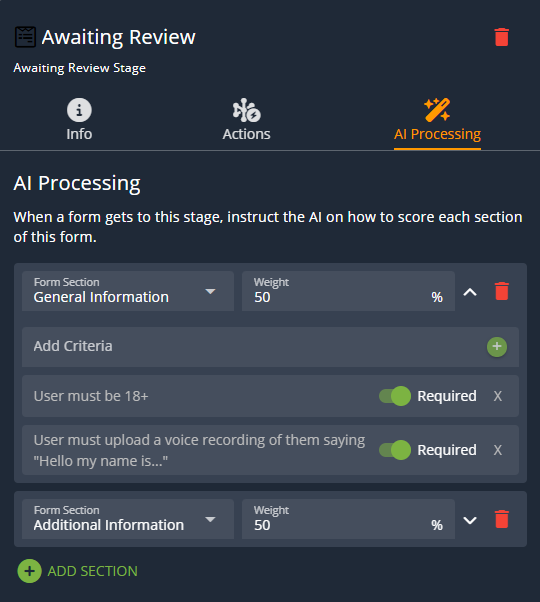
For each section of your form, you can define criteria for the AI to score responses. Criteria can be marked as required or preferred, and each section can be assigned a scoring weight to determine its importance. Every section visible to the user (see: form dependencies) will be scored. To set this up:- Select Add Section.
- Choose the section from the drop-down.
- Assign a weight (how much this section should influence the overall score).
- Add your custom criteria.
Setting Scoring Rules
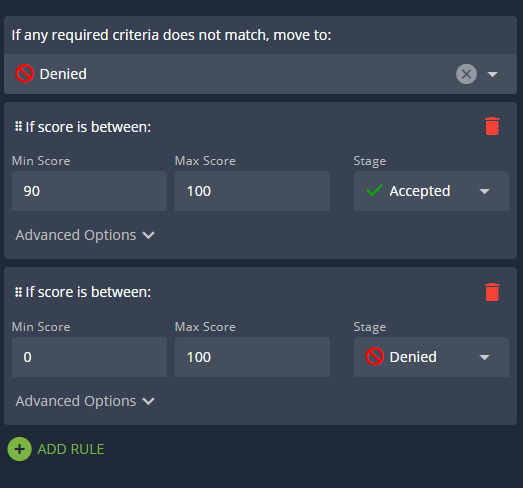
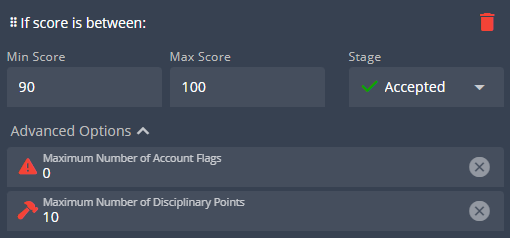
In the Scoring section, the dropdown lets you specify a stage if any required criteria are missed. For example, if your application requires applicants to be 18+ but the user is underage, the form can automatically be moved to the Denied stage regardless of other responses. Rules are applied according to their hierarchy and can be reordered using drag-and-drop. Next, define the scoring rules that determine how forms progress:- Select Add Rule.
- Enter the minimum score.
- Enter the maximum score.
- Choose the form stage to move to.
Disciplinary Points & Account Flags Rules can also include limits on disciplinary points and account flags:
- Account Flags are added when alternate accounts are detected.
- Disciplinary Points are assigned by staff when users have prior infractions.
AI Processing Reason
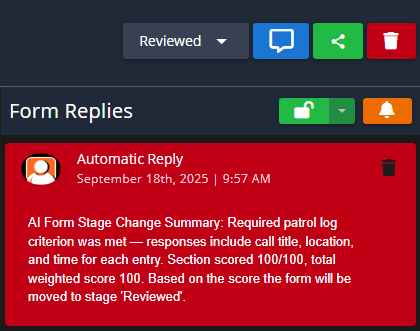
When the AI updates a form’s stage, it will leave a private comment on the submission explaining its scoring rationale. These private comments are visible to anyone with theAccess Private Comments permission on that form.
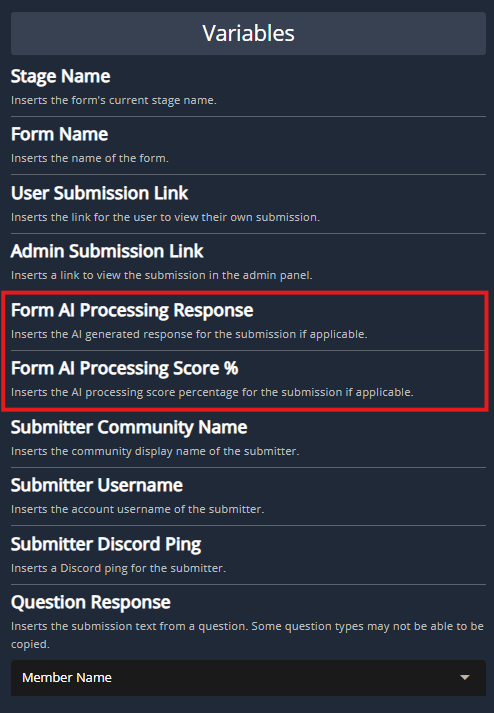
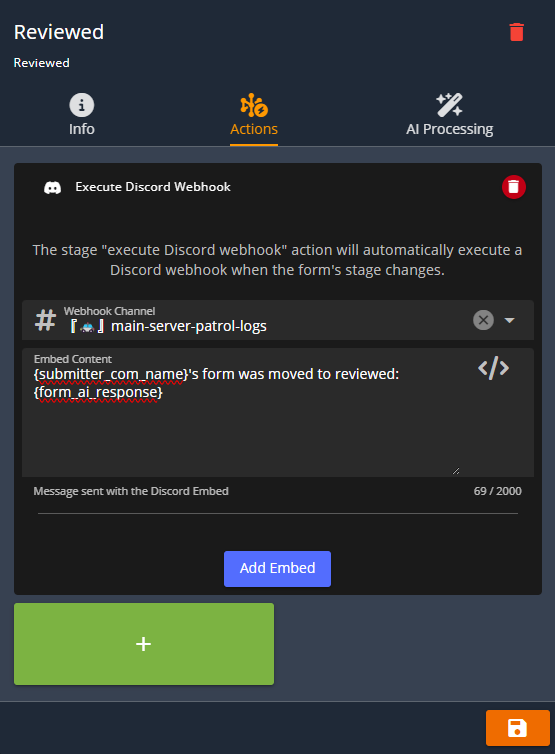
Additionally, the AI’s reasoning and score % can be included in any stage action—such as a Discord webhook—to provide context on why the form was advanced to a new stage.
Limits
To prevent abuse, all Pro communities are limited to 100 AI form submissions per 24-hour period. Current usage can be tracked in the Community Limits panel. If your community requires more than 100 submissions within 24 hours for legitimate purposes, please contact our support team to request an increased limit.Tips and Tricks
Using “Likely” Accepted/Denied Stages
AI form processing is a powerful way to handle the majority of submissions. It can quickly filter out low-quality responses and highlight the best applications. For critical applications—especially those that automatically add or remove ranks—it’s recommended to route them to “Likely Accepted” or “Likely Denied” stages. This ensures the AI speeds up the process while still allowing a final human review before a decision is made.Account Flags
Account Flags help protect your community against alternate accounts and ban evasion. If an applicant has active flags on their account, it’s recommended to route their submission to a Manual Review stage for further investigation before approval.Form Submission Limits
Because AI-powered forms can be processed in seconds, it’s important to guard against abuse. To prevent users from “brute forcing” submissions, communities can set limits on how often a form type can be re-submitted. The form editor provides two control options:- Submission limits – Set a maximum number of submissions allowed within a defined timeframe.
- Cooldown period – Require a minimum waiting time between individual submissions.
Troubleshooting
{formairesponse} variable is 'N/A'
{formairesponse} variable is 'N/A'
Whenever a form is moved to a stage—whether manually or by the AI—the stage’s actions fire immediately.The 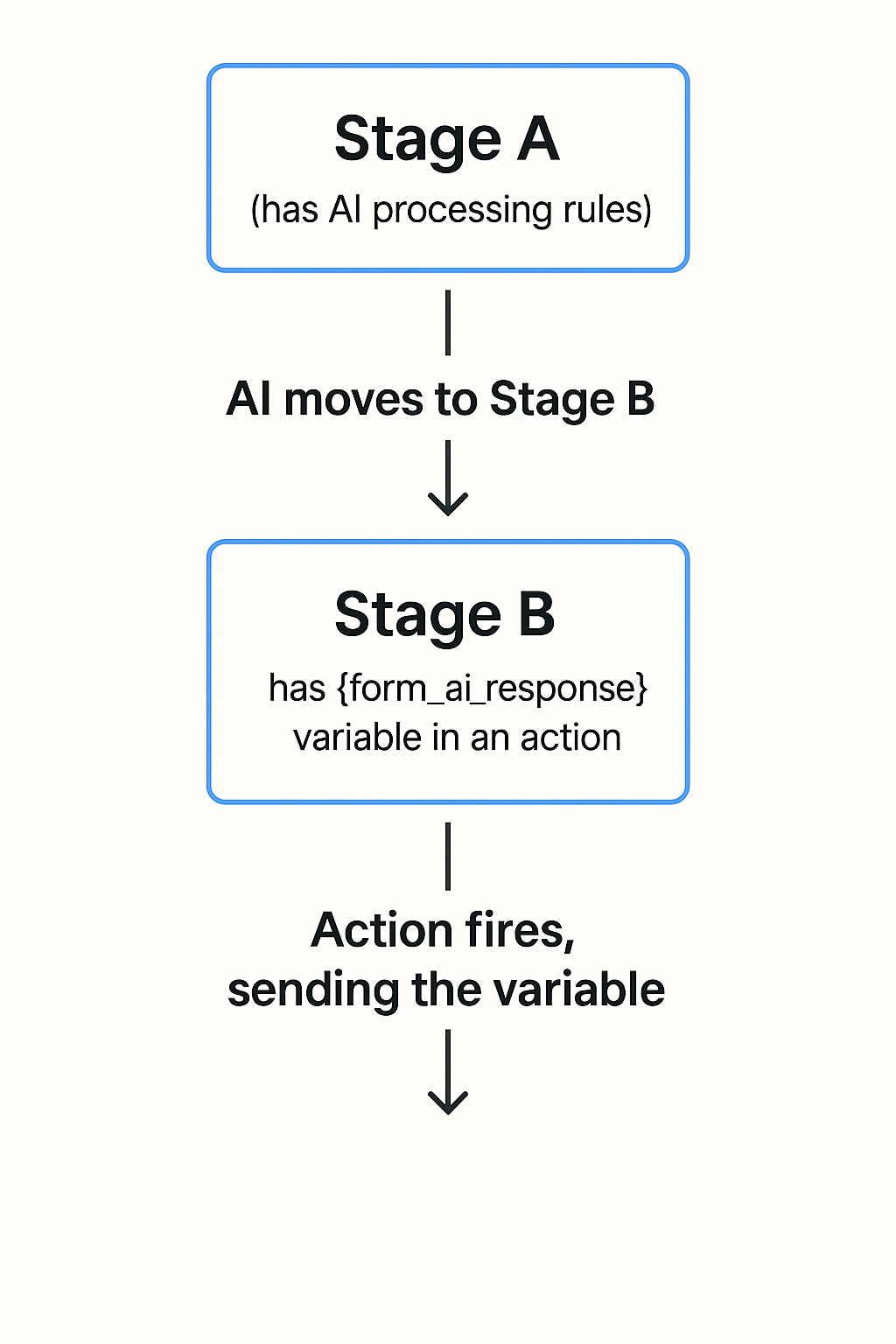
{form_ai_response} variable is automatically populated with the latest AI reasoning reply.This variable is only available when the AI itself has moved the form from one stage to another.AI is Not Moving the Stage
AI is Not Moving the Stage
AI form processing applies only to the specific form stage where it is configured.
To trigger AI processing, the form must be in that configured stage. Once active, the AI will:
To trigger AI processing, the form must be in that configured stage. Once active, the AI will:
- Evaluate the form submission.
- Post a response in the submission comments.
- Move the form to the next stage (if applicable).
[Stage with AI Rules] → [New Stage]❌ Invalid flow:[Stage without AI] → [Stage with AI]Loop PreventionIf the AI moves a form from Stage A to Stage B, the AI processing rules configured on Stage B will not run automatically.This safeguard prevents recursive AI loops that could continuously move the form back and forth between stages.